
Questions, answered straight.
Weight loss, hair loss, longevity & energy — everything below is general information, written plainly. The decisions about your care are made by a medical provider licensed in your state. If your question isn’t here, message us.


Getting Started
What is Ladies First?
Ladies First is a women's telehealth service: you complete an online intake, a medical provider licensed in your state reviews it, and if treatment is appropriate, medication ships to your door. Programs cover weight loss with GLP-1 medications, hair-loss treatment, and longevity & energy options — and in every one of them, a provider decides what fits, not a menu. Ladies First itself is a telehealth platform — it doesn’t provide medical care. All medical care is provided by our medical provider partner, an independent network of US-licensed medical providers, and medication is dispensed by licensed pharmacies. Programs include brand-name FDA-approved medications and compounded options. Everything is online and 100% self-pay.
Is Ladies First legit?
Yes. Ladies First is a women's telehealth platform certified by LegitScript, an independent healthcare certification service (certificate 47682256) — the same certification Google, Meta, and Microsoft require before a healthcare business is allowed to advertise. Medical care is provided by our medical provider partner, an independent network of US-licensed medical providers, and prescriptions are filled by state-licensed pharmacies. Every price is shown before you pay, and you're charged when you complete your visit — if a provider decides a treatment isn't appropriate for you, you're refunded. You can confirm all of this yourself: see our LegitScript certification page, and read member reviews on Trustpilot.
How do I verify Ladies First's certification?
Visit LegitScript's website and search for itsladiesfirst.com, or use the verification link on our LegitScript certification page. Our certificate ID is 47682256. LegitScript is an independent service that reviews and monitors healthcare businesses for legal compliance and transparent practices, so its certification is an outside check on who we are — not something we grade ourselves.
Is Ladies First a doctor's office or a pharmacy?
Neither — Ladies First is a telehealth platform, not a care provider. Medical care is provided by our medical provider partner, an independent network of US-licensed medical providers, and any medication is dispensed by licensed pharmacies. A medical provider licensed in your state makes every medical decision: whether treatment is appropriate for you, which medication, and what dose. Our job is to make finding that care simple and honest.
How does the process work, start to finish?
Four steps. First, a 3–5 minute online intake — no payment required to start. Second, a medical provider licensed in your state reviews your health history, usually within 48 hours. Third, if treatment is appropriate, your provider prescribes and a licensed pharmacy ships medication to your door. Fourth, ongoing check-ins, messaging support, and provider-guided dose adjustments. Plan options are shown at the end of the medical intake, with your exact price shown before you enter payment.
Who is eligible — and who isn't?
Eligibility is decided by a medical provider based on your full health history, not a checkbox — and each program has its own rules. For weight loss: GLP-1 medications are not appropriate during pregnancy or breastfeeding, and not appropriate for people with certain conditions — including a personal or family history of medullary thyroid carcinoma or MEN 2 — and members with active or prior eating disorders are not eligible. For hair loss: several medications are incompatible with pregnancy, breastfeeding, or planning pregnancy, and dutasteride is an absolute stop. Longevity options are reviewed the same way, and sometimes the honest answer is no. If you're unsure, the intake exists for exactly this: a licensed provider reviews your situation and makes the call.
Do I pay anything before I'm approved?
Payment is collected when you complete your medical intake — your exact price is shown before you enter any payment details. A licensed medical provider then reviews your information within 24–48 hours, and treatment ships only if they approve. There are no sign-up fees or membership fees, and standard weight-loss labs are covered at no cost to you.
How long does the provider review take?
Usually within 48 hours of completing your intake. A medical provider licensed in your state reviews your health history and either approves treatment, asks follow-up questions, or lets you know the program isn't a fit. Timing can vary with volume and with your state, and some reviews happen the same day.
Do I need insurance to use Ladies First?
No — Ladies First is 100% self-pay, and insurance is never required or billed. What you see is what you pay. We don't work with insurance in any way — no claims, no networks, no prior authorizations. If you want to pursue coverage for a branded medication such as Ozempic®, Wegovy®, or Zepbound® through your own plan, that's a conversation to have directly with your insurer.
How Care Works
What type of provider will I see?
You'll work with licensed providers who can prescribe medication, order lab tests when needed, and build a treatment plan around your health history and goals. Every provider is licensed in the state where you live, and the same care team stays available for follow-up questions through messaging.
Will I need lab work?
That's your provider's call. Some members are approved after the intake review alone; others are asked to complete lab work first so the provider can see a fuller picture before prescribing. If labs are part of your plan, your standard labs are covered — ordered through Quest or Labcorp at no cost to you. Your provider will tell you exactly what's needed and why before anything moves forward.
What support do I get after I start?
Ongoing care, not a one-time prescription. Your plan includes provider check-ins, messaging access to your care team, and dose adjustments guided by how your body responds. If side effects come up or something feels off, you message a person — and a provider decides what to change. Refills continue as long as your provider determines treatment remains appropriate.
Is my health information private?
Yes. Your health information is handled under HIPAA, transmitted encrypted, and shared only with the people involved in your care — your medical provider and the dispensing pharmacy. We don't sell your health data. You can review the privacy policy for the full details of what's collected and how it's used.
What does Ladies First treat?
Three programs today: weight loss with GLP-1 medications, hair loss, and longevity & energy — NAD+, sermorelin, and B12 MIC. Because weight and hormones are tangled together, topics like PCOS, insulin resistance, perimenopause, and menopause are part of the conversation your provider can have with you — the point is the whole picture, not just a number on a scale. In every program, a medical provider licensed in your state decides what, if anything, is appropriate for you.
Weight-Loss Medications: Branded vs. Compounded
What is semaglutide?
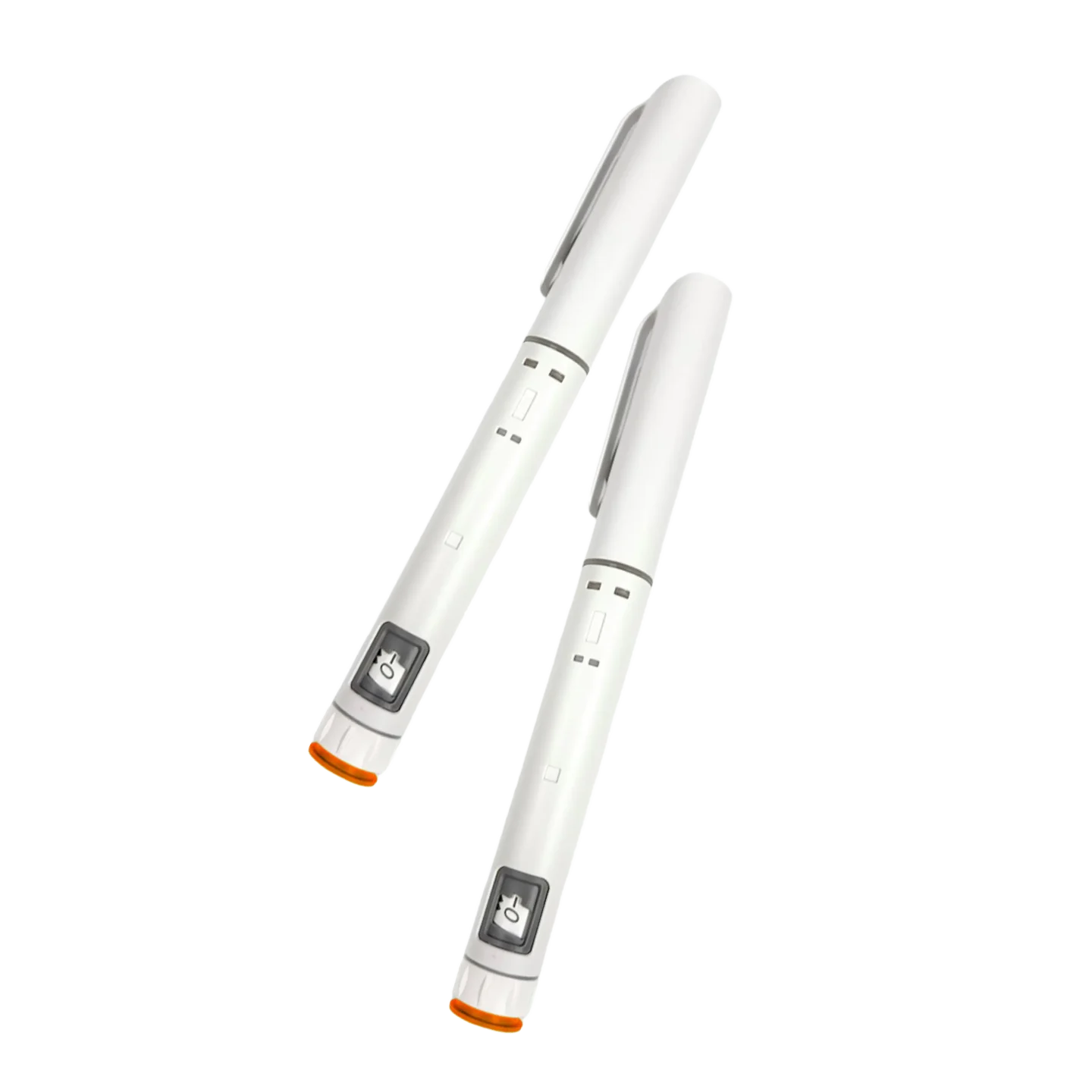
Semaglutide is a GLP-1 receptor agonist — a medication that mimics GLP-1, a hormone your body releases after eating. It quiets appetite signals, slows how quickly your stomach empties, and helps steady blood sugar, which together make it easier to eat less without white-knuckling it. Brand-name semaglutide is sold as Ozempic® (FDA-approved for type 2 diabetes) and Wegovy® (FDA-approved for chronic weight management), both from Novo Nordisk, taken as a once-weekly injection. Compounded semaglutide is a separate preparation, made by a state-licensed compounding pharmacy to an individual prescription. It is not FDA-approved and is not a generic equivalent or substitute for the branded products.
What is tirzepatide?
Tirzepatide is a dual-action medication that mimics two hormones — GLP-1 and GIP — that regulate appetite and blood sugar. Brand-name tirzepatide is sold as Mounjaro® (FDA-approved for type 2 diabetes) and Zepbound® (FDA-approved for chronic weight management), both from Eli Lilly, and like semaglutide it's a once-weekly injection. In published trials of the branded products, tirzepatide produced larger average weight loss than semaglutide — though "more on average" isn't automatically right for you; your provider decides. Compounded tirzepatide is a separate preparation and is not FDA-approved.
What's the difference between Ozempic and Wegovy?
Both are semaglutide, from Novo Nordisk, with different FDA approvals and dosing. Ozempic® is approved for type 2 diabetes, with weekly doses up to 2 mg. Wegovy® is approved for chronic weight management, with weekly doses up to 2.4 mg. Both are Novo Nordisk medications. In practice, which one a provider prescribes depends on what's being treated, insurance rules, and availability — for weight care specifically, Wegovy® is the one studied and labeled for that purpose. Your provider will tell you which, if either, fits your situation.
What is compounded semaglutide — and how is it different from Wegovy or Ozempic?
They are different regulatory categories. Brand-name semaglutide is FDA-approved and patent-protected by Novo Nordisk. Compounded semaglutide is a separate preparation made by state-licensed compounding pharmacies — it is not FDA-approved, and trial results from the branded products don't automatically transfer to it. Compounding pharmacies are FDA-regulated, which is a different and important distinction. Whether a compounded or brand-name option is appropriate for you is a medical decision your provider makes.
Are compounded GLP-1 medications safe?
Compounded GLP-1s are not FDA-approved, so the honest answer is: they carry the known safety profile of the active ingredient, plus the added variable of the preparation itself. They're made by state-licensed compounding pharmacies operating under USP standards, but no agency reviews each formulation the way the FDA reviews a branded drug — quality rests on the pharmacy. That's why provider oversight and a licensed pharmacy matter so much. Published safety data comes from trials of the brand-name FDA-approved products; compounded preparations were not part of those trials. Your provider will walk through the risks for your situation.
Can you still get compounded semaglutide?
Yes — compounded semaglutide remains available through state-licensed compounding pharmacies in specific circumstances, and Ladies First offers compounded options where a medical provider determines one is appropriate for you. The rules have tightened: after the FDA declared the branded shortages resolved, large-scale compounding of copies wound down, and the regulatory landscape continues to evolve. That's one reason we also offer brand-name FDA-approved medications — your provider decides which path fits, and we'll be straight with you if availability changes.
Does Ladies First offer brand-name, FDA-approved GLP-1s?
Yes. Alongside compounded options, Ladies First programs include brand-name FDA-approved medications such as Ozempic®, Wegovy®, and Zepbound® when your provider determines one is appropriate. Branded prescriptions through Ladies First are self-pay like everything else — we don't bill or coordinate with insurance. Plan options — including which medications are available to you — are shown at the end of the medical intake, after a provider has what they need to review your eligibility.
Weight-Loss Medications: Choosing, Comparing & Switching
Does tirzepatide work better than semaglutide?
In the large head-to-head trial of the branded products (SURMOUNT-5), where each medication was titrated to its maximum tolerated dose, participants taking Zepbound® (tirzepatide) lost an average of 20.2% of body weight over 72 weeks, versus 13.7% with Wegovy® (semaglutide). Those are averages from trials of the brand-name FDA-approved medications — compounded preparations were not part of them — and individual results vary. "More on average" doesn't mean right for you: side-effect tolerance, health history, and cost all matter, and your provider weighs all of it before deciding.
Can I switch from semaglutide to tirzepatide — or the other way?
Yes — switching between GLP-1 medications is common and medically manageable, but it's a provider-led transition, not a swap you make yourself. Providers typically consider a switch for tolerance issues, a plateau, availability, or cost, and they choose an appropriate starting dose on the new medication rather than matching milligram-for-milligram — the two drugs aren't dose-equivalent. If you're wondering about a switch, message your care team; your provider will decide whether it makes sense and map the transition.
Can you take semaglutide and tirzepatide together?
No — they aren't prescribed together. Both act on overlapping GLP-1 pathways, the combination hasn't been studied for safety or added benefit, and stacking them would raise side-effect risk without evidence it helps. If one medication isn't delivering what you hoped, the answer is a dose adjustment or a provider-managed switch, not doubling up. Tell your provider what's behind the question — that's usually where the real fix is.
Do oral semaglutide pills work for weight loss?
Oral semaglutide is real — Rybelsus®, a brand-name FDA-approved tablet, is used for type 2 diabetes — but the weight results that made GLP-1s famous come from the weekly injections, which deliver the medication more reliably. Higher-dose oral versions for weight management have been studied and options continue to evolve. For now, most weight-care prescribing uses injections. If needles are the obstacle, say so in your intake — your provider can talk through what's realistic for you. Individual results vary.
What's the difference between semaglutide and phentermine?
They're very different medications. Phentermine is an older stimulant-type appetite suppressant approved for short-term use — typically a few weeks — and it doesn't address the hormonal signals behind hunger. GLP-1 medications like semaglutide are designed for ongoing weight management and produced substantially larger average weight loss in published trials of the brand-name products (individual results vary; compounded preparations were not part of those trials). The two are generally not combined. Which, if either, fits your situation is your provider's call.
How do I know which medication I'll get?
You don't pick a medication from a menu — a medical provider licensed in your state chooses, based on your health history, your goals, and how your body responds. The intake gathers what matters (history, current medications, preferences), the provider reviews it, and plan options appear at the end of the medical intake once your eligibility is clear. If your first medication isn't working for you, your provider can adjust the dose or manage a switch — that's part of ongoing care, not a new sign-up.
Using Your Weight-Loss Medication: Storage, Doses & Daily Life
Does semaglutide have to be refrigerated?
Yes — plan on refrigeration. Brand-name pens are stored in the refrigerator (36–46°F) before first use, with limited room-temperature allowances that vary by product, so check the label. Compounded semaglutide vials come with the pharmacy's own storage instructions and should go into the refrigerator when they arrive. If your medication sat out too long or your fridge failed, don't guess — contact the pharmacy or your care team before injecting. Heat can degrade the medication without changing how it looks.
How long does semaglutide last in the fridge — and does it expire?
It expires like any medication, and the date to trust is the one on your label. Branded pens carry a printed expiration date plus a shorter in-use window once opened. Compounded semaglutide carries a beyond-use date assigned by the compounding pharmacy — often a matter of weeks once dispensed, which is much shorter than a branded expiration date. Refrigeration doesn't extend either one. When in doubt, contact the pharmacy, and never use medication past its date.
Can I take my semaglutide dose a day early?
Generally yes. The branded labeling allows changing your weekly dose day as long as at least 48 hours — two full days — pass between doses, so taking it a day early for travel or a schedule change is usually fine. It just shouldn't become a habit; if you're routinely drifting earlier, tell your care team. And if you're unsure how your plan handles timing, ask your provider — it's a 30-second message, not a guess.
What if I miss a dose?
For the branded once-weekly medications, the labeling says: if you're within 5 days of the missed dose, take it as soon as you remember, then return to your regular day. If more than 5 days have passed, skip it and take the next dose on schedule — don't double up. Compounded schedules follow your provider's instructions, which typically mirror this. If you've missed more than one dose, message your care team before restarting; after a longer gap, providers sometimes step the dose back down.
Can you drink alcohol on semaglutide?
There's no absolute ban, but the combination deserves respect. Alcohol can amplify nausea and stomach upset — the most common GLP-1 side effects — and because you're eating less and your blood sugar runs steadier, drinks can hit harder than you're used to. Many members also find their interest in alcohol simply drops; appetite and reward signals overlap. If you drink, start lighter than usual and see how you respond — and be honest about alcohol in your intake so your provider can advise you properly.
Can you take semaglutide with metformin — or with phentermine or berberine?
It depends on the medication. Metformin and semaglutide are commonly prescribed together, particularly where insulin resistance is part of the picture — but only a provider makes that call. Phentermine plus a GLP-1 hasn't been well studied and is generally not combined. Berberine is an unregulated supplement that can also affect blood sugar, so it isn't a harmless add-on. The rule that covers all of it: list every medication and supplement in your intake, and let your provider decide what's safe together.
Weight-Loss Results & What to Expect
Does semaglutide actually work?
Yes — in clinical trials of brand-name FDA-approved semaglutide (Wegovy®), participants lost about 15% of body weight on average over 68 weeks, alongside diet and activity changes. It works by changing appetite biology, not by testing your willpower. Compounded semaglutide was not part of those trials, and individual results vary — some people lose more, some less, and a small share don't respond much at all. What it doesn't do is work alone: the trials paired medication with lifestyle support, which is exactly how a good program should be built.
How does a GLP-1 help you lose weight?
It turns down the biology that makes eating less so hard. GLP-1 medications mimic a hormone your body releases after eating: appetite quiets, "food noise" fades for many people, your stomach empties more slowly so fullness lasts longer, and blood sugar stays steadier so there are fewer crash-and-crave cycles. You still choose what to eat — the medication just stops your body from fighting you so hard. That's why protein, strength, and sleep still matter: the medication creates the opening; habits do the building. Individual results vary.
How much weight can you lose on a GLP-1?
In the branded trials: about 15% average body-weight loss with Wegovy® (semaglutide) over 68 weeks, and up to about 21% average at the highest dose of Zepbound® (tirzepatide) over 72 weeks — both alongside lifestyle changes. Those are averages from trials of the brand-name FDA-approved products; compounded preparations were not studied in them, and individual results vary widely. A provider can help you set a target that's realistic for your body and history instead of chasing someone else's number.
How long does it take semaglutide to kick in?
Appetite changes often show up within the first couple of weeks. Meaningful weight change usually takes longer, because dosing deliberately starts low and steps up over several months to keep side effects manageable. In the branded trials, weight loss accumulated steadily over about a year to reach the averages usually quoted. If nothing has budged after the early months at a therapeutic dose, that's a provider conversation — adjust, switch, or reassess — not a reason to quietly quit. Individual results vary.
How long do you stay on semaglutide? Do you have to take it forever?
There's no fixed end date — providers treat weight as a long-term condition, managed the way blood pressure is, so many people stay on treatment well past the first year. Forever isn't required, but it's honest to say appetite typically returns when the medication stops. Some members eventually taper off with provider guidance and hold their results with habits; others do best with ongoing maintenance treatment. Your provider revisits the question with you as your body and goals change.
What happens when you stop taking semaglutide? Can you stop cold turkey?
When the medication stops, appetite comes back — usually within weeks — and without a deliberate plan, regain is common: in a branded-trial follow-up, participants regained roughly two-thirds of lost weight within a year of stopping. There's no withdrawal syndrome, so stopping abruptly isn't dangerous the way stopping some medications can be — but don't do it silently. Tell your provider first: they can taper the dose, time the stop, and shore up the habits that protect your results. Individual results vary.
Will I keep the weight off if I stop?
Some of it, if the habits underneath are strong — but honestly, appetite typically returns when a GLP-1 stops, and some regain is common without sustained changes. That's why providers frame these medications as part of a long-term plan built on protein, strength training, sleep, and steady routines rather than a short course. If finishing medication-free is your goal, say so — your provider can plan for it deliberately instead of leaving it to chance. Individual results vary.
Weight-Loss Medications: Safety & Side Effects
Is semaglutide safe? How long has it been around?
Semaglutide has one of the deepest evidence bases in modern weight care. The GLP-1 class has been used clinically since 2005; semaglutide itself was approved as Ozempic® in 2017 and as Wegovy® for weight management in 2021, with safety tracked across large multi-year trials and millions of prescriptions since. "Safe" is still personal: known risks rule some people out entirely, which is why a licensed provider reviews your history before anything is prescribed. That safety record belongs to the brand-name FDA-approved products — compounded preparations are separate and were not part of those trials.
What are the side effects I should actually know about?
The most common are gastrointestinal — nausea, vomiting, diarrhea, constipation, and abdominal discomfort — especially when starting or increasing a dose, and they usually ease as your body adjusts. That's exactly why providers raise doses slowly. Less common but serious risks include pancreatitis and gallbladder problems, and there's a boxed warning about thyroid C-cell tumors seen in animal studies. Your provider reviews all of it against your history before you start, and stays reachable by message if anything comes up after.
How long do side effects last — and when do they start?
Side effects tend to cluster around dose changes: nausea or stomach upset often appears within a day or two of an injection, is most noticeable in the first weeks at a new dose, and typically fades as your body adapts to each level. Many people have little or nothing after the adjustment period. If a side effect is persistent, worsening, or interfering with eating and drinking, message your provider — doses can be paced differently. Severe abdominal pain is different: that needs medical care right away, not a message.
Does semaglutide cause cancer?
No causal link to cancer has been established in humans. The concern comes from rodent studies, where semaglutide caused thyroid C-cell tumors — that finding drives the boxed warning and is why a personal or family history of medullary thyroid carcinoma or MEN 2 rules treatment out completely. Human data hasn't shown the same effect, but the screening exists for a reason: your provider reviews your history first, and you should report a neck lump, hoarseness, or trouble swallowing promptly during treatment.
Can semaglutide cause pancreatitis?
Pancreatitis is a known but uncommon risk — cases have been reported with GLP-1 medications, which is why it's taken seriously in screening. If you've had pancreatitis before, say so in your intake; whether a GLP-1 is appropriate for you is exactly the kind of call your provider is there to make. Know the warning sign: severe, persistent abdominal pain — sometimes radiating to your back, with or without vomiting — means stop the medication and seek medical care immediately.
Can semaglutide make you tired?
Yes — fatigue is a recognized side effect, most often early on or after a dose increase. It's frequently indirect: you're eating substantially less than your body is used to, and if protein or fluids drop too low, energy follows. For most people it passes as the body adjusts and eating stabilizes. If tiredness is persistent or heavy, tell your provider — pacing the dose, adjusting nutrition, or checking for something unrelated are all on the table.
Can semaglutide affect your period?
Cycle changes aren't a listed common side effect, but meaningful weight loss on its own can shift your cycle — for some it becomes more regular (this comes up often with PCOS), for others temporarily less predictable. There's an important flip side: as cycles regulate, ovulation and fertility can return, and these medications are not appropriate in pregnancy — so use reliable contraception if pregnancy is possible for you. Mention any cycle changes to your provider; they're worth tracking, not worrying over silently.
Can I take a GLP-1 while pregnant, trying to conceive, or breastfeeding?
No — GLP-1 medications are not appropriate during pregnancy or while breastfeeding, and they're stopped ahead of a planned pregnancy: the branded labeling advises discontinuing semaglutide at least two months before trying to conceive. If you become pregnant during treatment, stop the medication and contact your provider right away. If pregnancy is anywhere in your plans, put it in your intake — your provider will factor the timing into whether and how treatment makes sense now.

Hair Loss: The Basics & Your Treatment Options
Why does hair loss happen in women?
Everyone sheds — 50 to 100 hairs a day is normal. Female-pattern hair loss is different: under the influence of genetics and hormones, individual follicles slowly miniaturize, and each new hair grows in a little finer and a little shorter than the last. That's why it shows up as a widening part and thinner overall density, while the hairline usually holds. And pattern loss isn't the only driver — thyroid conditions, low iron, significant stress or illness, postpartum shedding, and certain medications can all push hair out faster than it grows back. These are medical factors, not something you can willpower through, and they're exactly what a medical provider evaluates during your consult. For the biology in plain language, read Women's Hair Loss: Why It Happens.
How do I know if I'm actually losing hair — or just shedding normally?
The pattern tells you more than the count. Fifty to a hundred hairs a day in the brush or shower is baseline, not loss. A part that's gradually widening, lower overall density, or a ponytail that keeps slimming down — with a hairline that mostly holds — often points to female-pattern hair loss, and that's worth a consult. A sudden, heavy increase in shedding weeks to months after stress, illness, childbirth, or a medication change is often temporary and can have a treatable driver like a thyroid condition or low iron — also worth a consult, and mention the trigger. One practical tool: photograph your part in the same light once a month. Real change is too gradual to see in the mirror day to day, and a medical provider makes the actual call.
What kinds of hair loss can be treated online — and what needs in-person care?
Gradual thinning — the widening part, the slow drop in density — is what an online consult handles well. But some patterns need hands-on care, and we'd rather tell you than prescribe anyway: hair loss that's sudden, patchy, or rapid, or that comes with scalp pain, scarring, rash, or burning, can signal conditions that need in-person evaluation. If a medical provider can't treat you safely online, you'll be refunded in full — and where possible, they'll point you toward the right kind of care instead.
What hair-loss treatments does Ladies First offer?
A full menu of prescription topical and oral treatments plus scalp support: minoxidil 5% foam, two compounded topical formulas, low-dose oral minoxidil, spironolactone, dutasteride, ketoconazole 2% shampoo, and biotin. One rule before anything else: you don't pick from that list like a shopping menu. A medical provider licensed in your state prescribes the option — or combination — that fits your health, your pattern of loss, and your goals, and only what fits. Plans run $29 to $89 every 28 days depending on what's prescribed, shipping included, and every option and price is posted on the hair-loss page.
Most hair-loss treatments aren't FDA-approved for hair loss — so what does “off-label” mean?
Here's what most hair companies won't say plainly: only one medication ingredient class is FDA-approved to treat hair loss in women — topical minoxidil. Everything else, on our page and every competitor's, is either prescribed off-label or compounded. Off-label means a medication is FDA-approved for one condition and prescribed for another based on a provider's clinical judgment — it's legal and common across medicine, and it's how oral minoxidil (approved as a blood-pressure medication), spironolactone (approved as a diuretic), and dutasteride (approved for prostate enlargement in men) are used for women's hair loss. Compounded formulations are mixed to a prescription by state-licensed compounding pharmacies and are not FDA-approved. We label which is which on every option, every time.
What is topical minoxidil — and does it work?
A once-daily 5% foam, applied to the scalp where thinning shows. No other medication ingredient is FDA-approved for women's hair loss — topical minoxidil is the one, approved for decades. It works at the follicle to extend the hair's growth phase, which is why it's the backbone of most plans. Honest notes: it can cause scalp irritation, and a temporary uptick in shedding in the first weeks is normal — that's follicles restarting their growth cycle, not the treatment failing. Individual results vary. $75 every 28 days, shipping included.
What is low-dose oral minoxidil?
One small daily tablet (2.5 mg). Oral minoxidil isn't FDA-approved for hair loss — it's FDA-approved as a blood-pressure medication, and at low doses it's prescribed off-label for hair loss, a use that's become increasingly common for women who'd rather skip a daily topical. Honest notes: it can cause unwanted hair growth elsewhere (most often fine facial hair), lightheadedness, or ankle swelling, so your provider reviews your blood pressure and health history first. $59 every 28 days. There's also a compounded once-daily capsule that pairs a gentler 1 mg dose with biotin and supporting nutrients ($79 every 28 days) — like all compounded preparations, it is not FDA-approved.
What is spironolactone — and why is it prescribed for hair loss?
An anti-androgen tablet (50–100 mg). Spironolactone isn't FDA-approved for hair loss — it's FDA-approved as a diuretic and blood-pressure medication, and it's prescribed off-label for hair loss when hormones are driving the pattern, because it blunts the androgen activity that miniaturizes follicles. Honest notes: it is not compatible with pregnancy, and it can affect potassium levels and blood pressure, so your provider weighs your health history and may recommend periodic checks. $59 every 28 days. For the full plain-language picture, read Spironolactone for Hair Loss in Women.
What is dutasteride?
The strongest DHT-reducing option — and the one with the most non-negotiable fine print. Dutasteride isn't FDA-approved for hair loss — it's FDA-approved for prostate enlargement in men and prescribed off-label for women's hair loss; it reduces DHT, a hormone byproduct that shrinks susceptible follicles. It can harm a developing baby, and it stays in the body for months after the last dose — which is why pregnancy, breastfeeding, or planning pregnancy is a hard stop, not a judgment call. Your provider screens for this every time, and if it applies to you, they'll steer you to a different option. The 0.5 mg tablet is $59 every 28 days; a low concentration also appears in one of the compounded topicals below.
What are the compounded topical formulas?
Two made-to-prescription options from state-licensed compounding pharmacies — and like all compounded preparations, they are not FDA-approved. The Triple Topical ($85 every 28 days) combines minoxidil 5% with tretinoin 0.005%, which helps the minoxidil absorb, and fluocinolone 0.01%, a low-dose corticosteroid that calms the irritation treatment can bring; it's not for use during pregnancy, because tretinoin is a retinoid. The Dual-Action Topical ($89 every 28 days) is the most aggressive topical: minoxidil 5% plus tretinoin 0.025% and a low concentration of dutasteride (0.1%) — and dutasteride's rule holds even in topical form: it must not be used if you are pregnant, breastfeeding, or planning pregnancy. Your provider screens for this before prescribing, every time.
Do ketoconazole shampoo and biotin actually help?
Honestly: they're supporting players, not headliners. Ketoconazole 2% is a prescription-strength shampoo — not a regrowth treatment on its own, and we won't pretend it is — FDA-approved for flaky, inflamed scalp conditions and used off-label two to three times a week in hair-loss routines, because a calmer, healthier scalp gives treatment a better field to work on. $35 every 28 days. Biotin 10,000 mcg is a daily supplement, and here's the honesty most brands skip: research supports biotin for hair mainly when you're actually deficient, which most people aren't. If your provider thinks it's a sensible add-on, it's here — nobody will upsell you into it. One practical note: high-dose biotin can interfere with certain lab tests (including thyroid tests), so tell any provider ordering labs that you take it. $29 every 28 days.
Hair Loss: Expectations, Safety & Logistics
How long until I see results from hair-loss treatment?
The honest timeline: in weeks 1–6, shedding may briefly get worse (more on that below). Months 3–6 are the turn — shedding typically settles first, then early regrowth shows up as fine, short hairs along the part. Months 6–12 are when visible density change builds, if it's coming. Take a photo of your part in the same light once a month — real change is too gradual to see day to day. And a truth worth saying plainly: in hair medicine, keeping what you have is a win; regrowth is the bonus on top. Individual results vary, and your provider will set expectations that fit your pattern — not a stranger's.
My shedding got worse after I started. Is the treatment failing?
Almost always the opposite. When minoxidil restarts sluggish follicles, the old resting hairs they were holding release first to make way for new growth — so more hair in the brush in the first several weeks is usually a sign the medication is engaging, not failing. We say this up front because it's the exact point where most women quit too early. The uptick typically settles as new growth comes in. If shedding is severe or continues past the early months, message your provider — that's exactly what your reviews are for.
What if my hair-loss treatment doesn't work for me?
That's a provider conversation, not a dead end. Every 12 weeks, your provider re-checks your progress in an online refill review and can adjust the dose, change the formula, or switch you to a different option — or combination — when a change makes sense. That's part of ongoing care, not a new sign-up. It's also honest to say response varies: some women regrow noticeably, some mostly keep what they have, and some don't respond. Individual results vary — which is exactly why the plan is reviewed instead of set-and-forgotten.
Will I keep the results if I stop hair-loss treatment?
These treatments manage a condition — they don't switch it off permanently. If you stop, gains typically shed back over the following months. That's not a sales line; it's how the biology works, and you deserve to know it before you start, not after. If you're thinking about stopping — cost, side effects, life changes — message your provider first: they can talk through what stopping actually means for your pattern and whether a different option fits better.
Why does the intake ask for photos of my hair?
Because that's how a medical provider assesses your pattern online — no video call, no waiting room. The intake asks for photos of your part line and your crown, taken in good lighting, so the provider can see the pattern and density of loss and prescribe what actually fits it. Those photos also become your baseline: compare against a same-light photo every month or so and you'll have a far more honest progress record than the mirror will ever give you.
Can I use hair-loss treatments while pregnant, breastfeeding, or planning pregnancy?
Several of these medications are off the table if you're pregnant, breastfeeding, or planning pregnancy — and dutasteride is an absolute stop even at the planning stage: it can harm a developing baby and remains in the body for months after the last dose. The tretinoin-containing topicals are also not for use during pregnancy, because tretinoin is a retinoid. Your provider screens for pregnancy, breastfeeding, and family planning during intake — and the screening is not a formality. They'll only consider options that are safe for your situation, or none, if that's the honest answer.
What side effects should I know about with hair-loss treatments?
Each medication carries its own honest notes, and your provider reviews all of them against your history before prescribing. Topical minoxidil can cause scalp irritation, plus the temporary early-weeks shedding uptick. Oral minoxidil can cause unwanted hair growth elsewhere (most often fine facial hair), lightheadedness, or ankle swelling. Spironolactone can affect potassium levels and blood pressure, so your provider may recommend periodic checks. Dutasteride's defining risk is pregnancy-related — it's a hard stop if pregnancy is anywhere in your plans. If anything comes up once you've started, message your care team; adjusting is normal care, not a complaint.
How do hair-loss refills, check-ins, and plan changes work?
Your prescribed treatment ships free to your door every 28 days from a licensed pharmacy. Every 12 weeks, your provider re-checks your progress in an online refill review — no appointment needed — and adjusts the formula or dose when a change makes sense. Between reviews, messaging support is included. Billing follows the same rhythm as everything else at Ladies First: plans renew every 28 days, you can cancel any time and future cycles stop, and past payments are not refundable except as set out in our Refund Policy.

Longevity & Energy: NAD+, Sermorelin & B12
What longevity and energy options does Ladies First offer?
Three: NAD+ (as a self-administered injection or a nasal spray), sermorelin (an injection), and B12 MIC (an injection). All three are prepared by state-licensed compounding pharmacies and are not FDA-approved. This category attracts bigger promises than almost any other, so here's ours: we'll describe each option accurately, show you the honest state of the research — including where it's thin — and put a medical provider licensed in your state between you and any prescription. Sometimes the answer is no, and we'd rather tell you that than sell you something. Every option and price is posted on the longevity & energy page.
What is NAD+?
Nicotinamide adenine dinucleotide — a coenzyme found in every cell in your body, involved in how cells convert food into usable energy. At Ladies First it's prescribed as a self-administered injection or a nasal spray, prepared by a state-licensed compounding pharmacy — and, like all compounded preparations, it is not FDA-approved. For the candid state of the research, read What Is NAD+? The Honest Evidence for Women.
NAD+ injection vs. nasal spray — what's the difference?
The form, and how you take it: the injection is self-administered; the spray goes in through the nose. Both are prepared by state-licensed compounding pharmacies — like all compounded preparations, they are not FDA-approved — and both carry the same honest evidence picture — small human studies show supplementing can raise NAD+ blood levels, and whether that changes how you feel hasn't been established in rigorous human trials. Which form fits you — including how you feel about needles — is a conversation for your intake, and your medical provider makes the call. Both are priced the same.
Does NAD+ actually work? Will it give me more energy or slow aging?
We can't promise that — and the honest answer is that no one can, because the evidence to promise it does not exist. What's actually known is narrower: small human studies show that supplementing can raise NAD+ levels in the blood. Whether raising those levels changes how you feel, slows any aspect of aging, or improves long-term health has not been established in rigorous human trials — most of the exciting findings so far come from lab and animal studies. That's the honest state of the science, and your medical provider will discuss it with you before anything is prescribed. Anyone who tells you more than that is selling past the evidence.
What is sermorelin?
A synthetic fragment of growth-hormone-releasing hormone (GHRH). Rather than injecting growth hormone itself, sermorelin prompts your pituitary gland to release your own. And here's what's worth knowing before anyone sells it to you: there is no FDA-approved sermorelin product on the market today — the previously approved version was discontinued by its manufacturer in 2008, and every sermorelin prescription in the US is now compounded, prepared by state-licensed compounding pharmacies.
What does the evidence show for sermorelin?
It's thin, and we'll say so plainly. Sermorelin was studied decades ago, mainly as a diagnostic tool and in children with growth-hormone deficiency. Evidence for wellness use in healthy adults amounts to small, short studies — without large trials showing benefits you'd actually notice. Your medical provider weighs that record against your health picture before prescribing anything, and declining is a legitimate outcome of that review.
What is a B12 MIC injection?
Vitamin B12 combined with methionine, inositol, and choline — the “MIC” in the name — as a self-administered injection prepared by a state-licensed compounding pharmacy (not FDA-approved). For what it honestly is and isn't, read B12 and MIC Injections: What They Are.
Do I actually need extra B12?
Only your levels and your history can answer that. B12 has one clear, well-established use: correcting a documented B12 deficiency. If your levels are normal, extra B12 has not been shown to add anything — and we won't suggest otherwise. The MIC blend has a long tradition in weight-management clinics but thin trial evidence behind it. If your medical provider suspects a deficiency or sees a specific reason for it in your health picture, they'll say so; if not, they won't prescribe it.
Not one of the longevity options is FDA-approved — why does that matter?
Because you deserve to know which regulatory category you're buying from before you spend a dollar. All three options are prepared by state-licensed compounding pharmacies, and the FDA does not review compounded preparations for safety, efficacy, or quality before they are marketed. Sermorelin goes a step further: there is no FDA-approved sermorelin product on the market at all today. None of that is a secret menu or a loophole — it's a different regulatory category, and telling you which is which, plainly, is the baseline of honesty in this space.
What might I actually notice on a longevity plan — and when?
We won't script an experience for you, because rigorous human trials haven't established outcomes you'd reliably notice — that's the honest baseline for this whole category. What we can tell you is how the check-ins work: your provider reviews how it's going at your first refill review, 3–4 weeks in, and you decide together whether the plan is earning its place. If it isn't, stopping is simple — cancel any time, and future billing cycles stop. Individual results vary, and “I didn't notice a difference” is a perfectly good thing to tell your provider.
Who shouldn't use NAD+, sermorelin, or B12 — and can the provider turn me down?
Yes, they can turn you down — and that's the system working, not failing. A medical provider licensed in your state reviews your full health history and prescribes only when an option is appropriate for you; if it isn't, they decline, and you're refunded in full. There's no fixed list we can print that replaces that review, because the answer depends on your health picture — medications, conditions, and history all factor in. Sometimes the most valuable thing this program can give you is a no.
How much do the longevity and energy options cost?
Every price, posted: NAD+ and sermorelin are $199 for your first 4 weeks, then $239 every 28 days — or $597 per 12 weeks (billed every 12 weeks, which works out to $199 per 28 days). B12 MIC is $145 every 28 days, or $375 per 12 weeks (billed every 12 weeks — $125 per 28 days). Shipping is included, there are no membership or sign-up fees, and no surprise price hikes — if pricing ever changes, you'll know in advance. Plans renew every 28 days — that's 13 cycles across a 364-day year, and we do that math for you because most brands hope you won't.
How do check-ins and refills work on a longevity plan?
Your initial visit is asynchronous — a health history you complete on your own time, reviewed by a medical provider licensed in your state, with no appointment to book. Your first refill review comes at 3–4 weeks, so your provider checks how it's going before your first refill. After that, refills move to a 12-week rhythm with ongoing provider oversight, and you can reach your care team with questions between reviews. Cancel any time — future cycles stop billing, and past payments are not refundable except as set out in our Refund Policy.
Can I add NAD+, sermorelin, or B12 to my weight-loss plan?
Yes. All three options can be added to an existing weight plan during a provider review — at the same prices posted on the longevity page. Nothing costs more as an add-on, and nothing costs less as a standalone: one price, posted. Whether an add-on is appropriate for you is your provider's call, made the same way as every other prescribing decision here.
How should I read longevity marketing claims — including yours?
Three rules. One: a mechanism is not an outcome — “involved in cellular energy metabolism” is a fact about biochemistry, not a promise about how you'll feel, and when copy slides from the first to the second, that's the trick. Two: animal studies are not human results — much of what makes this category exciting happened in mice and cell cultures, and human evidence is the bar that matters. Three: raising a level is not the same as feeling different — a number moving on a lab report doesn't establish a benefit you'd notice. Hold every brand to these rules. Especially us.

Pricing, Billing, Shipping & Cancelling
How much do Ladies First weight loss plans cost?
It depends on the program — and every price is posted before you pay anything. Weight loss: compounded semaglutide starts at $219 per 28 days on a 12-week plan (billed every 12 weeks), or $249 every 28 days on the flexible plan; compounded tirzepatide is $309 per 28 days on a 12-week plan, or $339 every 28 days on the flexible plan. Longer commitments bring the per-28-day price down further — with 24- and 52-week plans, compounded semaglutide starts as low as $179 and compounded tirzepatide as low as $269 per 28 days, billed once per term ($1,194 or $2,327 for semaglutide; $1,734 or $3,497 for tirzepatide). Brand-name medication pricing depends on your prescription and insurance situation.
Hair loss: plans run $29 to $89 every 28 days depending on what your provider prescribes. Longevity & energy: NAD+ and sermorelin are $199 your first 4 weeks, then $239 every 28 days (or $597 per 12 weeks); B12 MIC is $145 every 28 days (or $375 per 12 weeks). Every plan, in every program, includes the provider consultation, ongoing messaging support, and shipping — no membership or sign-up fees, standard weight-loss labs covered at no cost to you, and no insurance required. Exact plan options and totals are shown at the end of the medical intake, before you pay anything. See our Honest & Upfront Pricing Guarantee →
Why do the 12-week plans cost less per 28 days?
Because you're paying for a longer stretch at once. The 12-week plans are billed every 12 weeks, and that longer billing cycle earns a lower per-28-day price — $219 versus $249 for compounded semaglutide, $309 versus $339 for compounded tirzepatide. The flexible plans bill every 28 days with no long-term commitment, and 24- and 52-week plans push the per-28-day price lower still. The same logic applies on the longevity plans: 12-week terms are billed once per term at a lower per-28-day rate. Same medication, same care, same support either way; the only difference is how you'd rather be billed. Either can be cancelled any time, which stops future billing cycles.
How often will I be billed?
On the flexible plans, every 28 days — and there's a medical reason it's 28 and not "monthly." The weight-loss medications run on a weekly rhythm: a 28-day cycle is exactly four weeks, every cycle — four doses of a weekly injection, or four full weeks of a daily one — no matter what the calendar is doing. Months stretch from 28 to 31 days, so "monthly" billing slowly slides out of step with weekly dosing; a 28-day cycle keeps your refills, your doses, and your billing moving together. Hair-loss and longevity plans renew on the same 28-day cycle, and longevity also offers 12-week terms billed once per term.
On the money side, said plainly: that's 13 billing cycles across a 364-day year, not 12. On the 12-week plans, you're billed once every 12 weeks. We show the per-cycle price and the billing cadence up front, before you enter payment. If a charge ever confuses you, message us — the answer to a billing question should always be boring.
Will my price go up as my dose increases?
No — your per-cycle price stays the same at every dose level. Some clinics charge more as your dose steps up; Ladies First doesn't. And no surprise price hikes: if pricing ever needs to change, you'll hear it from us in advance, before it touches a billing cycle — never as a surprise on your statement.
Does Medicare, Medicaid, or TRICARE cover this? Do you take insurance?
Ladies First doesn't bill insurance at all — the program is 100% self-pay, so no coverage is required and there are no insurance hoops. On the public programs generally: coverage of weight-management GLP-1s under Medicare, Medicaid, and TRICARE varies by plan and state and keeps changing, so check your specific plan directly rather than trusting a general answer. If you want to pursue coverage for a brand-name medication under your own plan, that process runs directly between you, your plan, and your prescriber — Ladies First doesn't handle insurance paperwork.
How does shipping work?
Your medication ships from a licensed pharmacy directly to your door, with shipping included in your plan price — no pharmacy lines, no pickup windows. If your medication needs refrigeration, the label will say so — follow it as soon as your package arrives. Shipments are timed to your billing cycle so you're not left counting doses. If a package is delayed, damaged, or arrives in poor condition, don't use it on a guess — contact your care team or the pharmacy first and we'll make it right.
How do refills work?
Refills continue automatically as long as your provider determines treatment remains appropriate — you don't chase anyone. The check-in rhythm depends on your program: weight-loss plans include a quick check-in around refill time so your provider can confirm the dose still fits; hair-loss plans get a provider re-check every 12 weeks in an online refill review; longevity plans start with a refill review at 3–4 weeks, then move to the same 12-week rhythm. Any medication or dose change is provider-approved and coordinated so the right thing ships next. If something needs to change — timing, dose questions, a pause to discuss — message your care team before your next billing cycle rather than after.
Can I cancel? Do you offer refunds? Can I change plans later?
You can cancel any time, and future billing cycles simply stop — no long-term contract, no cancellation fee. Past payments aren't refundable, so if you're going to cancel, do it before your next billing cycle rather than after. Changing is just as easy: message your care team to move between the 12-week and flexible billing cadences, and medication or dose changes go through your provider as part of normal care. Nothing about leaving — or coming back — is designed to be hard.
Still wondering if this is for you?
See If You Qualify